Islamist Watch
Latest Posts  |  Archive  | 

Cartoon Chaos!

Islamists can be rather sensitive about cartoons. In early 2006, worldwide riots erupted in response to caricatures of Mohammed that had been published by the Danish newspaper Jyllands-Posten several months prior. Recent cases in Canada and the U.S. demonstrate that lawful Islamists have taken up the burden of enforcing doodle dhimmitude.

At the behest of a local Muslim group, police in Halifax, Nova Scotia, have opened a hate crime investigation over a cartoon that mocks a couple demanding compensation for a terrorism probe.

The cartoon, published April 18 in the Chronicle Herald newspaper, depicts a woman in a burqa holding a sign that reads, "I want millions," and she says, "I can put it towards my husband's next training camp."

The cartoon by Bruce MacKinnon is a reference to Cheryfa MacAulay Jamal, a woman from Nova Scotia whose husband was arrested in 2006 in an anti-terrorism raid. Qayyum Abdul Jamal was released from jail after charges against him were stayed on April 15.

An official at the paper rightly noted that the drawing does not take aim at all Muslims and therefore cannot be a hate crime under Canadian law: "The whole purpose of that cartoon was to comment on the outrageous demands of this individual for compensation long before any hearing into her case had ever been held."

The Chronicle Herald may have learned a lesson from the Columbus Dispatch. Last year, the Ohio office of the Council on American-Islamic Relations complained that the paper had published what CAIR-OH called a "Nazi-style" cartoon that shows cockroaches emerging from a grate marked "extremism" at the general location of Iran.

The Dispatch hammered CAIR for promoting a "false grievance," as the roaches are clearly not referring to Iranians in general. Those who wrote letters at the urging of the pressure group received this dressing-down in response:

CAIR also likens the cartoon to Nazi propaganda. This is a remarkable display of intellectual gymnastics. Iranian President Ahmadinejad has called for the destruction of the Jewish state and questions the Holocaust, while his regime tries to develop nuclear weapons. If CAIR is truly concerned about the promotion of Nazi ideas and the use of Nazi methods, it should direct its attention to Tehran.

When CAIR and friends try to manufacture controversy, it's best just to "toon" them out.

By David J. Rusin  |  Thu, 15 May 2008 at 1:01 PM  |  Permalink  |  TrackBack (0)

UK Firms Place a Premium on Shari'a-Compliant Insurance

Two years ago Gordon Brown outlined a plan to make Britain a world center of Islamic trade and finance. While his government maneuvers to become the first in the West to issue a Shari'a bond, the UK's private sector is already cashing in on the Muslim market. The advent of Islamic-oriented insurance policies represents the latest example:

Britain's first independent Islamic insurance company has received authorization by the Financial Services Authority (FSA).

Principle Insurance will provide unique, Shari'a-compliant (or halal) motor and home insurance to British residents from later this year.

[…]

Principle chief executive Bradley Brandon Cross added: "Some elements of conventional UK insurance, such as the earning of interest, the investment of policyholders' funds, and uncertainty mean that it is not in accordance with Muslim beliefs.

"We are going to be offering unique insurance products that meet a genuine need and are also competitively priced."

In a related news item, FoneShield is rolling out the first Shari'a-compliant insurance plans for mobile phones. The director insists that these policies are not just a cynical attempt to earn a few extra pounds: "They also compel us to meet an excellent ethical standard for our business."

Islamic insurance and associated financial structures utilize rather baroque schemes to circumvent Shari'a-dictated prohibitions, particularly those on interest. However, economics professor Mahmoud el-Gamal has argued that they employ interest in all but name. "Islamic finance today is interest-based," he explains. It is "first and foremost about religious identity."

The "genuine need" for Shari'a-compliant insurance therefore exists primarily on the part of those who aim to drive a wedge between Muslims and everyone else. Indeed, Shari'a finance was designed by twentieth-century Islamist intellectual Abul-Ala Mawdudi as a means to "minimize relations with non-Muslims, strengthen the collective sense of Muslim identity, extend Islam into a new area of human activity, and modernize without Westernizing."

Insurance is a mechanism for mitigating risk, but Shari'a-compliant policies may actually promote more of it in the long term.

By David J. Rusin  |  Mon, 12 May 2008 at 9:26 AM  |  Permalink  |  TrackBack (0)

"Divorce me once, shame on you…"

The big news out of Maryland this week concerns a 21-page opinion on Islamic divorce, decided unanimously by the state Court of Appeals. And herein lies the rub: The justices have refused to recognize the talaq break-up, which requires that the husband address "I divorce thee," three times in succession, to his wife.

The Baltimore Sun reports:

Yesterday, the Court of Appeals rejected a Pakistani man's argument that his invocation of the Islamic talaq, under which a marriage is dissolved simply by the husband's say-so, allowed him to part with his wife of more than 20 years and deny her a share of his $2 million estate.

The justices affirmed a lower court's decision overturning a divorce decree obtained in Pakistan by Irfan Aleem, a World Bank economist who moved from London to Maryland with his wife, Farah Aleem, in 1985.

Farah's attorney believes that Irfan, who not long ago retired, and now lives in Pakistan, appealed to talaq and tradition to preserve the integrity of his World Bank pension, which provides him with $90,000 annually.

The couple, who married in Karachi in 1980, signed a marriage contract requiring that Irfan pay the equivalent of $2,500 to his wife in the event of divorce. And when Farah initiated proceedings in 2003, Irfan did exactly this, believing himself absolved of obligation to his wife.

"Maryland's highest court disagreed," however.

"If we were to affirm the use of talaq, controlled as it is by the husband, a wife, a resident of this state, would never be able to consummate a divorce action filed by her in which she seeks a division of marital property," the judges wrote in their decision.

They said the talaq "directly deprives the wife of the due process she is entitled to when she initiates divorce litigation."

Muneer Fareed, secretary-general of the Islamic Society of North America (ISNA), acknowledged: "For the most part, Muslims expected this kind of ruling […]. The contrary would be a surprise to them. They do not expect the U.S. legal system to give full recognition of talaq." He also agreed that "[Irfan] was trying to defeat the ends of justice within the American legal system."

But Abdullahi Ahmed An-Na‘im, Islamic reformer, legal scholar, and Charles Howard Candler Professor of Law at Atlanta's Emory University, was more to the point: "There can only be one law of the land," he stated.

Professor An-Na‘im, who only just published Islam and the Secular State: Negotiating the Future of Shari‘a, argues that "if Muslims wish to influence what the law of the state says, they must do so through the normal political process and in accordance with civic discourse that is equally open for debate by all citizens, and not on the basis of religious beliefs."

In any case, he claims, "the legal doctrines of the Sharia in their original form, which go back to the seventh century, are simply incompatible with the realities of life in the 21st century."

This is a phrase one wishes to declare – once, twice, and three times again – for the benefit of Rowan Williams, Archbishop of Canterbury, who suggested earlier this year that Western Muslims are within rights to "choose to have marital disputes or financial matters dealt with in a Sharia court." Adopting "parts of Islamic Sharia law" can only "help maintain social cohesion," he offered.

Back in the Free State, however, an "ecstatic" and "relieved" Farah Aleem, who has struggled to make ends meet while pursuing an evening degree, is quick to explain: "All I ever wanted was my fair share, not a penny more."

Fortunately for Farah and her family, it appears the Maryland court's decision was a piece of (crab) cake.

By R. John Matthies  |  Fri, 9 May 2008 at 4:39 PM  |  Permalink  |  TrackBack (0)

Netherlands Trying to Ban Burqas Yet Again

The Dutch cabinet has moved to prohibit women in public sector jobs from donning the most extreme Islamic-inspired garments — the niqab, which covers one's face except for the eyes, and the burqa, which covers the entirety of one's body and head:

The cabinet proposal to ban face-covering clothing for government functionaries in education and in public transport is supported by the Lower House. But the Christian Democrats (CDA) and Labour (PvdA) disagree over a ban in the health sector.

The CDA wants to extend the "burqa ban" to the health sector. "We do not want any face-covering in healthcare, certainly not among the personnel," according to MP Madeleine van Toorenburg.

PvdA MP Jeroen Dijsselbloem is unconvinced. "The healthcare sector has never been asked for its opinion," he tried. But CDA's healthcare minister Ab Klink told Van Toorenburg he would study her proposal.

Dijsselbloem was actually also against a ban in education. "Naturally we do not want any burqas in the classroom. But schools that want to do so can ban face-covering clothing themselves. I am afraid we are shooting a midge with a cannon," he said before backing the cabinet proposal anyway.

MP Geert Wilders, the producer of the anti-Koran film Fitna, has complained that these regulations would not go far enough; he hopes to one day see burqas outlawed everywhere in public. Other conservatives "want a general ban of face-covering clothing, including balaclavas and blacked-out motorbike helmets, because this would reduce the chances of legal objections to discrimination based on religion."

The cabinet backed such a ban in late 2006. However, the proposal lost steam after a new government came into power and it eventually collapsed under concerns that a broad prohibition would violate religious liberties. Still, the more limited legislation is a positive first step.

There are two primary reasons to proscribe face coverings in public. First, unidentifiable people present a security risk; second, niqabs and burqas promote segregation. Nor is it difficult to see how the student-teacher relationship — or any other that requires significant personal contact — could be inhibited by the artificial wall of the veil.

Hopefully the medical sector will take up van Toorenburg's suggestion and get on board as well. After all, doesn't it have a special mandate to help maintain the health of society?

By David J. Rusin  |  Thu, 8 May 2008 at 1:41 PM  |  Permalink  |  TrackBack (0)

Gora! Gora! Gora!

It's not terribly difficult to locate opinion and commentary by moderate and reform-minded Muslims – provided, that is, one knows where to look. Pakistani-Canadian journalist Tahir Aslam Gora is one who fits the above description, and whose opinions merit our attention.

Gora writes from a suburb of Hamilton, Ontario, Canada, and publishes regularly in the Hamilton Spectator. He has recently published valuable pieces on the subjects of multiculturalism, Islamic banking and Shari‘a in the West; and Gora's latest, titled "Muslims, don't shun multiculturalism," is likewise worth a read.

Gora begins with the thought that "Muslims across the western world in general and in Canada in particular blame media for creating an environment of Islamophobia."

They think western media – including Canada's – have orchestrated a campaign to call Islam and terrorism the same thing.

But also in Canada, on the other hand, some progressive Islamic circles think Canadian media are too caught up in political correctness and don't dare air issues that question Islam in public debate.

Why is there a dire need for open debate within Islam?

The answer, simply, is that we Muslims are still part of a closed community.

Gora praises, in principle, the "multicultural mosaic would give us the opportunity to mix with all cultures in Canada." But he laments the fact that Canada's Muslims, instead, inhabit diversity's gated community, "encouraged [by Canada's intelligentsia and academy] to stay aloof from the multicultural blend."

What must result, he writes, is "alienation" – a term that speaks to religious segregation and institutional hypocrisy alike. And sadly for us all, he continues, the gatekeepers of politically correct orthodoxy will not allow a term like this to inform popular and political discourse.

The fact is, he continues: "This country's society is based on a separation of religion and state."

But when it comes to applying this core value to Muslims, policymakers start mixing religion with state affairs.

It is sad our secular colleges and universities are allocating special facilities to growing Muslim student groups to promote their religious services.

Unfortunately, these religious services on campuses eventually lead to or are dominated by fundamentalist ideologies.

Gora contends that "if we keep meeting Muslims' religious demands in non-religious places, society indirectly harbours Islamic radicalization. And when that happens, we shouldn't complain about alienation of Muslims." We will have done nothing to prevent this radicalization from festering, this is to say.

What's more:

There is a contradiction of ideas and actions in the way Canada's Islamic organizations and their leaders are advocating detachment from society at large and the way they are pushing themselves into the arena of national politics and policy.

That contradiction – that paradox – may push Canada and its Muslim communities into a state of pure alienation.

This is a bad thing, certainly, and stands to benefit only the most radical elements – at the expense of those Muslims, like Gora, who find a home in Canada, and insist that "Canadian society […] help Muslims become integrated with the core values" of their nation.

A wish to see Muslims integrated in such a way is not a "bad message," writes Gora; neither does this thought amount "racism," as some have claimed. It's rather a "more appropriate direction."

Hear, hear, Mr. Gora. And here's to seeking out your next installment.

By R. John Matthies  |  Wed, 7 May 2008 at 12:30 PM  |  Permalink  |  TrackBack (0)

Stop the Pandering, Say Secular Muslims

Frustrated by governments bending over backwards to accommodate Islam in the public square? Some Muslims are fed up with them as well, and a group in the UK has recently stepped forward to speak out on behalf of this "silent majority":

The government's attempts to placate Muslims will cause long-term damage to communities, a charity said yesterday.

The warning came from Yasmin Alibhai-Brown, chair and co-founder of the British Muslims for Secular Democracy, a new organization claiming to represent the "silent majority who feel no conflict between their faith and democracy."

Speaking before the launch, attended by Baroness Kishwer Faulkner and former Islamist Ed Husain, the journalist said the government was pandering to Muslims by granting too many concessions, fuelling their separation from the rest of society.

"The government has found a way of placating Muslims in a way that will only damage us in the long term, Muslims wanting separate schools or different measures. There must be one law for all.

"This differential accommodation leads to us being pushed to the edges. How is it that the Sikhs and Hindus can live in democracy but not Muslims?"

Originally founded in 2006, British Muslims for Secular Democracy (BMSD) aims "to promote civic engagement, social inclusion, responsible citizenship, and good governance, particularly within constituent Muslim communities of Britain in order to build an understanding of the shared values between all citizens to enable them to live in an inclusive, pluralist, secular, and confident Britain."

It is too early to tell whether BMSD will be the real deal, but there are reasons for optimism. Alibhai-Brown's comments echoed her group's censure of Archbishop Rowan Williams for suggesting that some aspects of Shari'a law should be accepted in the UK; a February press release called his position a "denial of the principles of gender equality and inclusion and shared citizenship" — a bold and welcome statement.

As Daniel Pipes frequently contends, "Radical Islam is the problem, moderate Islam is the solution." Moderate Muslims who work to integrate their community into the broader social framework are thus indispensable for neutralizing Islamism at its source.

How will we know that they have succeeded? When objections to pandering are no longer rare enough to make the news pages.

By David J. Rusin  |  Tue, 6 May 2008 at 11:33 AM  |  Permalink  |  TrackBack (0)

Separatist Islamic Group Can't Be Called 'Separatist Islamic Group' on BBC

While seeking to highlight the extremist sponsor of London's proposed mega-mosque, Britain's Christian Choice Party discovered that certain phrases are verboten on the nation's major television networks:

A Christian party has begun legal action after the [BBC] insisted on changes to a short film in which the party voiced opposition to the building of Europe's biggest mosque next to the site of the 2012 Olympics.

Tablighi Jamaat, the Islamic missionary group behind the £75 million Abbey Mills mosque, opposes inter-faith dialogue and preaches that non-Muslims are an evil and corrupting influence. One of its British advocates has said that it aims to rescue Muslims from the culture and civilization of Jews and Christians by creating "such hatred for their ways as human beings have for urine and excreta."

The Christian Choice election broadcast would have described Tablighi Jamaat as "a separatist Islamic group" before welcoming that some "moderate Muslims" were opposed to the mosque complex.

However, both BBC and ITV balked at these descriptions:

The BBC refused to accept "separatist" — the corporation asked for "controversial" instead — and barred the use of "moderate Muslims" because the phrase implied that Tablighi Jamaat was less than moderate.

ITV went a step farther, demanding that the adjective "controversial" be used merely to describe the planned mosque and not the group itself.

What could possibly be "less than moderate" about an organization that aims to place "Jews and Christians" on the level of "urine and excreta"?

"This was a politically correct attempt to close down reasoned discussion and debate. It's a matter of freedom of speech and democracy," said the Christian Choice Party's candidate for London mayor. His group had asked a court to review the broadcasters' decisions but was denied on procedural grounds. The party reluctantly aired a watered-down version; an uncensored cut is posted on YouTube.

The indispensable Melanie Phillips has offered this concise summary: "There is clearly no limit to British pusillanimity and sheer unadulterated funk when it comes to calling Islamic radicalism by even the most polite and restrained of proper names."

Well said, Ms. Phillips. Just don't try to say it on television.

By David J. Rusin  |  Fri, 2 May 2008 at 10:09 PM  |  Permalink  |  TrackBack (0)

Church's Chicken: An Example of Islam in the Private Sector

A lawsuit involving Church's Chicken shines a spotlight on the Islamic attributes of its business. It also offers a valuable opportunity to discuss the rights of owners and customers regarding Islam in the private sphere:

A Baltimore couple has filed a federal civil rights lawsuit against the Islamic investment bank that owns the Church's Chicken fast-food chain, alleging their franchise failed because the bank's strict adherence to the religious code of Shari'a prohibited the couple from selling pork.

Marcus and Denise Beasley, who are black, claimed they were treated differently by the bank, now known as Atlanta-based Arcapita Inc., than non-black franchisees who were allowed to continue serving breakfast dishes containing pork after the chain was acquired by the bank in December 2004.

The couple did not benefit from the grandfather policy allowing the sale of pork even though their contract with the chain's former owners, AFC Enterprises Inc., to open a location in Baltimore/Washington International Thurgood Marshall Airport's new terminal predated the takeover and policy change, according to the suit filed Tuesday in U.S. District Court in Baltimore.

This court will determine whether Arcapita, the American affiliate of Bahrain's First Islamic Investment Bank BSC, is guilty of discrimination or breach of contract. However, the aspect of the story that has received the most notice — the Shari'a-inspired prohibition on pork products at Church's Chicken — does not appear to raise any legal red flags.

A privately owned business may choose to sell or not sell whatever it wishes, as long as it does not violate the law or infringe upon the rights of others in the process. Customers have no inherent right to purchase pork at Church's Chicken franchises, and the company is under no obligation to offer it — regardless of the underlying motivation.

The free market, however, cuts both ways. Hungry Americans are not required to patronize any given restaurant. In the case of Church's Chicken, the absence of pork on the menu is just one excuse to eat elsewhere. Diners may also be concerned about what their money will fund at the Shari'a-compliant First Islamic Investment Bank in Bahrain.

Judging by reaction to this story in the blogosphere, the lawsuit itself could be the least of the problems facing Church's Chicken, whose business practices have clearly laid an egg in front of customers.

By David J. Rusin  |  Wed, 30 Apr 2008 at 12:01 PM  |  Permalink  |  TrackBack (0)

Courses from Egypt's Al-Azhar University Heading to Denmark

Danish Muslims will no longer have to visit Cairo to immerse their minds in the curriculum of Al-Azhar University, frequently cited as the center of learning in Sunni Islam. The classes are coming to them:

Well-educated Danish Muslims will soon be able to take Islamic university-level courses in law, economics, and international relations here in the country, reports Berlingske Tidende newspaper.

The Islamic Faith Society will begin offering graduate courses in conjunction with the Al-Azhar University in Cairo, one of the most renowned religious and intellectual institutions in the Muslim world.

The new venture intends to "confront misconceptions about Islam and explain the true Islam to the European society." One imagines this to be yet another response to the row over cartoons of Mohammed published by a Danish newspaper in September 2005.

But what kind of education will these students receive? For insight into the worldview that characterizes Al-Azhar, one must begin with Muhammad Sayyed Tantawi, the university's grand sheikh. In the 1970s Tantawi penned a 700-page tome that rationalizes Muslim Jew-hatred. More recently, he has praised suicide bombings of civilians and called for the beheading of anyone who insults the holy books or prophets of monotheistic faiths.

As for the curriculum of Al-Azhar, one former student — who was expelled and arrested for his publications on a reformist website — has written that the university promotes "things that contradict reason and incite to violence against people of other beliefs." A liberal professor at Cairo University has likewise criticized the school for employing the texts of "extremist sheikhs":

What kind of way of thinking are we teaching our next generation, that it has the right to attack other countries in order to convert them to Islam or to [make them] pay jizya, and that if they don't — we will annihilate them down to the very last one?

Which brings us to an even more troubling question: will they teach this same way of thinking to Muslims in Denmark?

By David J. Rusin  |  Sun, 27 Apr 2008 at 12:50 PM  |  Permalink  |  TrackBack (0)

Islamist Money Buying Clout in British Academia

Cash from international Muslim entities is funding Islamic studies programs in universities throughout the UK. A recent study has revealed the vast extent of these donations, which dwarf grants provided to schools by the British government:

Prof. Anthony Glees, director of Brunel University's Centre for Intelligence and Security Studies, claims that eight universities, including Oxford and Cambridge, have accepted more than £233.5 million from Saudi and Muslim sources since 1995, with much of the money going to Islamic study centers.

Glees' report, which is to be published by the Centre for Social Cohesion, part of rightwing think tank Civitas, says this is 200 times the amount the government is putting into Islamic studies and will allow one-sided views of Islam and the Middle East, and anti-democratic propaganda to prosper.

The Higher Education Funding Council for England is investigating whether foreign funds influence the curricula and research in Islamic studies programs. Some have suggested that this is already the case:

Dr. Denis MacEoin, Islam expert at Newcastle University, said academics were nervous about handling topics that might upset their sponsors.

"It's part of an overall belief that only Muslims can teach Islam, which in an academic context is entirely wrong. It would soon remove the possibility for genuine academic debate."

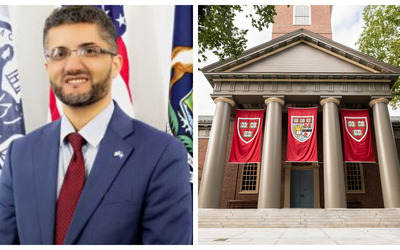
Such concerns are not limited to the UK. In 2005 Saudi businessman Prince Alwaleed bin Talal gave Harvard and Georgetown $20 million apiece "to teach about the Islamic world to the United States." This is the same prince whose $10 million gift to the Twin Towers Fund was rejected by Rudy Giuliani following bin Talal's suggestion that U.S. foreign policy had sparked 9/11.

An overview by the Institute for the Study of Islam and Christianity shows that Saudi-funded centers and endowed chairs are only slightly less common on American campuses than frat houses and wacky mascots. As to their goals, "While Saudi sources claim that the funding is given to help remove Western misunderstandings of Islam, evidence suggests that much of the motivation is founded in Islamic doctrines of mission (da'wa) and holy war (jihad) and aims at the spread of Islam (especially in its Wahhabi form) and its political dominance around the world."

You don't need an advanced degree from Cambridge or Harvard to spot the danger in that.

By David J. Rusin  |  Tue, 22 Apr 2008 at 11:57 AM  |  Permalink  |  TrackBack (0)

Islamist Watch Blog Archive

© 2007 - 2008 The Middle East Forum.